Tasks
The benchmark evaluates discrete units against gold phone sequences through three lenses: how much phonemic information the units carry (PNMI, ABX discriminability), how well they can be decoded into the right phones (PER), and whether their boundaries align with phone boundaries (segmentation).
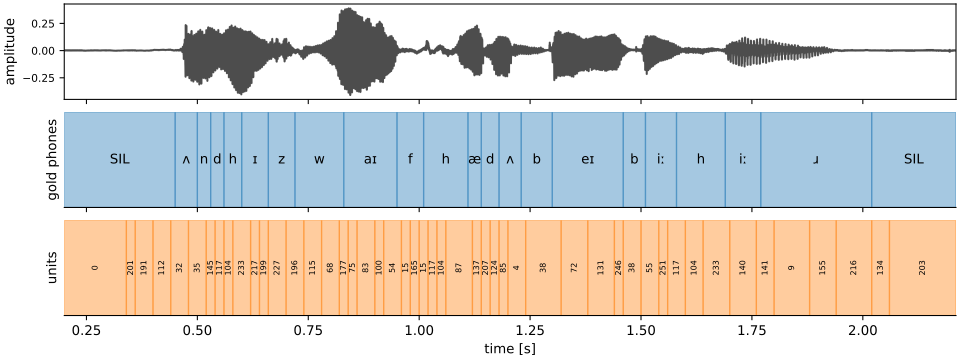
We illustrate each step on an example from the English test set, as shown above.
The waveform is an excerpt from 0188-135249-0001.wav, with its gold phonemic transcription and units predicted
by layer 5 of SpidR VP-20 finetuned on the 10h English split.
Mapping units to phonemes
Let \(\bm{u} = (u_1, \dots, u_T)\) be the sequence of discrete units to evaluate, corresponding to a full dataset split, and let \(\bm{p} = (p_1, \dots, p_T)\) be the corresponding sequence of gold phones, where \(T\) denotes the number of time steps at the resolution of the evaluated system. We denote by \(\mathcal{P}\) the predefined set of phonemes, and by \(\mathcal{U}\) the one of units. The empirical joint distribution of phones and units is
The many-to-one assignment maps each unit to its most frequent phoneme \(A: j \mapsto \arg \max_{i \in \mathcal{P}} \prob(i, j)\). The assigned sequence \(\bm{a} = (\bm{a}_1, \dots, \bm{a}_T)\) is obtained by applying this mapping at each time step: \(\bm{a}_t = A(\bm{u}_t)\).
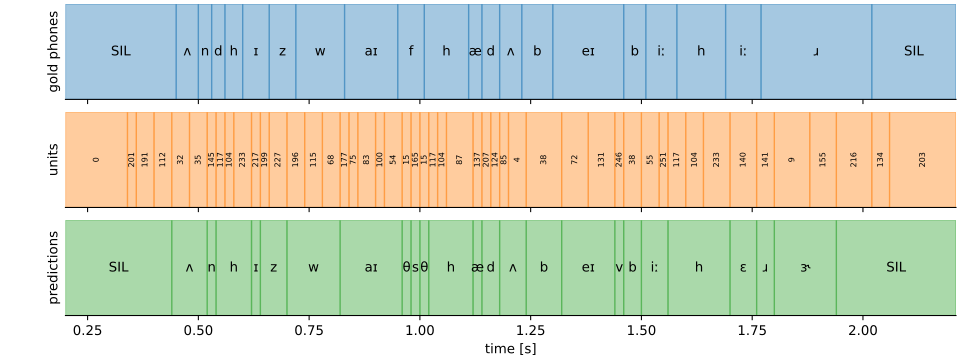
We ask participants to the benchmark to submit systems with 256 units, for fair comparison. Setting the vocabulary size is crucial: with this setup, an unconstrained many-to-one mapping can be improved by increasing \(|\mathcal{U}|\). In the extreme case where \(|\mathcal{U}| = T\) and where each unit appears exactly once, the mapping would be perfect. A fixed vocabulary size eliminates this confound.
For the one-to-one assignment, we impose each phoneme to be mapped to a single unit: \(A\) has to be a bijection. We derive it by solving the linear assignment problem that maximizes \(\prob(i, j)\) with SciPy.
Evaluation metrics
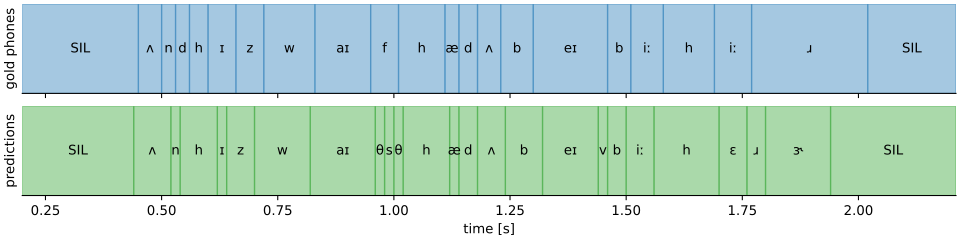
We now evaluate the quality of the predicted sequence of phones with the following metrics.
Units quality
The PNMI between \(\bm{p}\) and \(\bm{u}\) is:
where \(\prob_{\bm{p}}(i) = \sum_{j \in \mathcal{U}} \prob(i, j)\) and \(\prob_{\bm{u}}(j) = \sum_{i \in \mathcal{P}} \prob(i, j)\) are the marginal distributions. It measures the fraction of phone entropy explained by the discrete units.
Recognition

PNMI is sensitive both to units' quality and their alignment. Since the mapping produces a phone sequence \(\bm{a}\) from the units \(\bm{u}\), we compare it directly to the gold sequence \(\bm{p}\) by computing the PER to abstract away from the alignment.
In this example, the minimal number of edits consists of 4 insertions, 1 deletion, and 2 substitutions, making up for a PER of \((4 + 1 + 2) / 22 = 32\%\)
Segmentation
Recognition evaluates predicted labels but not their temporal alignment. Segmentation evaluation is complementary: it ignores labels and only compares boundary positions.
We report \(F_1\) and \(\bm R\)-value, which penalizes over-segmentation more than \(F_1\):
with \(\text{OS} = \frac{R}{P} - 1\) the over-segmentation, \(R = \frac{\text{TP}}{\text{TP} + \text{FN}}\) the recall, and \(P = \frac{\text{TP}}{\text{TP} + \text{FP}}\) the precision.
We allow a tolerance of \(\pm\)20 ms around each gold boundary and split overlapping windows at their midpoint, as shown below.
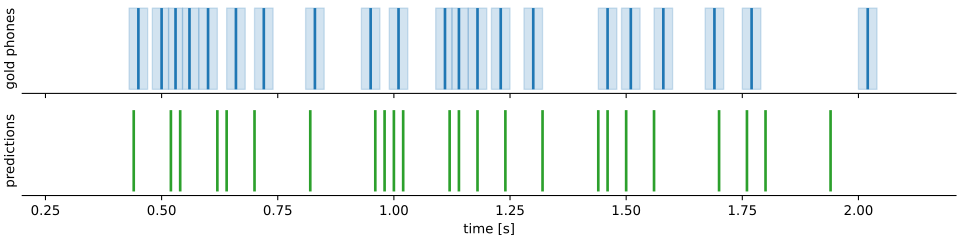
In this example, there are 18 true positives (green lines), 6 false positives (dashed red lines), and 3 false negatives (red areas): \(F_1 = 0.800\), \(R\text{-value} = 0.798\).

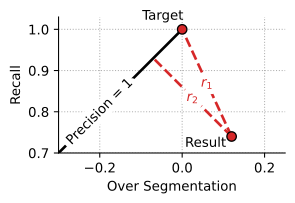 The $R$-value has a geometric interpretation. It represents how close the segmentation is from the ideal
$(\text{OS}, R) = (0, 1)$ point (with distance $r_1$) and the $P = 1$ line (with $r_2$) in the $R$, $\text{OS}$ space.
The $R$-value has a geometric interpretation. It represents how close the segmentation is from the ideal
$(\text{OS}, R) = (0, 1)$ point (with distance $r_1$) and the $P = 1$ line (with $r_2$) in the $R$, $\text{OS}$ space.
Discriminability
We provide utilities to optionally compute ABX discriminability on continuous representations of triphones or discrete units, using the fastabx library. ABX measures whether two instances of the same triphone (e.g., /bag/) are closer to one another in embedding space than to instances of a minimally contrasting triphone (e.g., /beg/). On discrete units, ABX is related to PNMI but with a hard threshold for success: two realizations of the same triphone must be encoded as the same sequence. On continuous representations, it is a useful proxy during development to guide pretraining and select intermediate layers with easily available phonetic information without requiring discretization.